



Casino VIP Programs in Australia: What to Check
 Available in AU
VIP status can shape tiers, cashback and personal offers, but it does not make offshore online casino services lawful in Australia.

Table of Contents
- Online VIP Claims Need a Reality Check
- What VIP Status Actually Means
- How Tier Progression and Reviews Work
- The Perks: Cashback, Hosts and Personal Offers
- Bonuses Come with Strings Attached
- Loyalty Points: What Play Earns and When They Expire
- What VIP Rewards Can Be Worth
- Crown Rewards, The Star Club and Playing In Person
- Private Rooms and Crypto: Check the Fine Print
- Which Games Count Most Toward VIP Progress?
Online VIP Claims Need a Reality Check
A VIP badge can make an online casino offer look established and exclusive. In Australia, though, that wording does not change the legal position. The Interactive Gambling Act 2001 prohibits operators from providing real-money online casino games to people who are physically in Australia. That includes slots, poker, blackjack and roulette. A foreign licence, a polished website or an invitation marked “VIP” does not turn those services into lawful Australian online casino products.
I used to treat a licence logo as a quick trust check. It tells you something about the licence claimed by an operator, but it does not answer the question that matters here: whether the operator may provide online casino games to people in Australia. Some offshore sites marketed to Australian readers state that they operate under a Malta Gaming Authority or UK Gambling Commission licence. Those are foreign licences, not Australian permission to offer prohibited online casino services here.
That distinction is easy to blur in promotional language. “Australian-friendly” may describe a site’s presentation or the customers it seeks; it is not a legal category that overrides the Act. Nor does a VIP label create an exception. A message offering a private contact, preferred treatment or a tailored online casino promotion remains a message about a service that Australian law prohibits operators from providing to people here.
A VIP label alone doesn’t tell you what a casino’s programme offers. Use these short verdicts to see what is verifiably known about each operator before you look for details relevant to you.
License: Curacao eGaming (Roby Games Ltd) The available information identifies Roby Casino’s licence as Curacao eGaming, held by Roby Games Ltd. No VIP-programme details are provided here, so you’ll need to check the operator’s terms for those.
License: Curacao eGaming OGL/2023/174/0082 (Dama N.V.) · Min. deposit: A$15 LevelUp Casino is listed with Curacao eGaming licence OGL/2023/174/0082, held by Dama N.V., and a minimum deposit of A$15. The available information doesn’t specify VIP benefits, so check the terms if those are important to you.
License: Curacao – Antillephone N.V. (Versus Odds B.V.) · Min. deposit: EUR 20 Thor Casino is listed with a Curacao licence from Antillephone N.V. for Versus Odds B.V.; its minimum deposit is EUR 20. No VIP-programme details are provided, so you’ll need to verify them with the operator.
Payout speed: crypto 30-120 minutes, fiat 24-72 hours · Min. deposit: A$30 MrPacho lists crypto payouts at 30–120 minutes and fiat payouts at 24–72 hours, with a minimum deposit of A$30. These details don’t describe its VIP programme, so check the operator’s terms for membership information.
License: Curacao Gaming Control Board OGL/2023/176/0095 (Hollycorn N.V.) Neospin is listed with Curacao Gaming Control Board licence OGL/2023/176/0095, held by Hollycorn N.V. The available information doesn’t detail a VIP programme, so you’ll need to check directly for its terms.
License: Curacao Gaming Control Board (TechSolutions Group N.V.) Bizzo Casino is listed with a Curacao Gaming Control Board licence held by TechSolutions Group N.V. No VIP-programme details are provided here; check with the operator if you’re assessing VIP membership.
License: Curacao Gaming Control Board OGL/2023/176/0095 (Hollycorn N.V.) Rollero Casino is listed with Curacao Gaming Control Board licence OGL/2023/176/0095, held by Hollycorn N.V. The available information doesn’t explain its VIP offering, so verify any programme terms directly.
License: Curacao Gaming Authority (Jumpman Gaming Ltd) DragonSlots Casino is listed with a Curacao Gaming Authority licence held by Jumpman Gaming Ltd. No VIP details are available here, so you’ll need to consult the operator for information about its programme.
License: Curacao Golden Pokies is listed with a Curacao licence. The information provided doesn’t specify its VIP programme, so check with the operator for details before relying on any VIP offering.
License: Curacao OGL/2024/1335/0780 · Min. deposit: EUR 20 Vegaz Casino is listed with Curacao licence OGL/2024/1335/0780 and a minimum deposit of EUR 20. No VIP-programme details are provided, so check the operator’s terms for information relevant to you.
There is a separate issue with advertising. Promoting an offshore online casino to Australians is not made acceptable by calling the offer an invitation, a loyalty benefit or a private deal. The wording may feel personal, but the legal character of the underlying service does not change. I have seen how easily a “special” message can feel like proof that the offer is legitimate. It is not proof.
The federal regulator is the Australian Communications and Media Authority, or ACMA. It oversees compliance with federal interactive gambling laws, including the Interactive Gambling Act. Where prohibited gambling services or advertisements are available online, ACMA can ask internet service providers in Australia to block access to the relevant websites. The regulator reports having blocked more than 1,455 illegal gambling and affiliate websites since enforcement action began in November 2019.
A block is practical evidence that enforcement is active, not a guarantee that every site will disappear permanently or that a page you can still open is lawful. Offshore sites and promotional pages may change addresses, and access can vary. I would not use temporary accessibility as a shortcut for deciding that an online VIP offer is safe or permitted. The key point stays the same: the operator cannot lawfully provide real-money online casino games to someone physically in Australia just because the website loads.
This also helps separate two things that can otherwise be muddled: in-person casino membership and online casino promotions. A named membership club at a physical venue is not the same thing as an offshore website advertising online VIP treatment. The online wording should not be read as evidence of an Australian licence, an exemption, or approval from ACMA.

The phrase “best VIP programme” can also sound like a consumer ranking, when the more important question is whether the underlying online service is lawful to offer here at all. Calling a site “the best” or presenting a tier as an exclusive benefit does not settle that question. Neither does a claim that a site welcomes Australian customers. Promotional language can describe what an operator says it offers; it cannot rewrite the law.
If a site combines online casino claims with foreign licensing details, read those as separate statements. The licence may be real in the jurisdiction that issued it, while the service remains prohibited for an operator to provide to Australians. That is the part I wish I had understood earlier: a badge can be genuine and still not mean what you need it to mean.
For an Australian reader, the safest interpretation of an online casino VIP pitch is a narrow one. It is an offshore marketing claim, not evidence that real-money casino games are authorised locally. No special tier changes that.
What VIP Status Actually Means
“VIP” sounds like a badge you earn after one impressive night. In practice, it can mean something much less dramatic: a place in a membership structure, with entry rules set by the operator. I used to read the label as proof that someone had already been singled out. That was too generous.
In a lawful, in-person casino programme, joining the base Tier may happen automatically once entry conditions are met, while higher Tiers may require invitations or the accumulation of points.
In a lawful, in-person casino programme, joining the base Tier may happen automatically once you meet the programme’s entry conditions. Higher Tiers are a separate matter. Some programmes require an invitation; others let members progress through accumulated points. So “VIP” does not tell you, on its own, whether you have been invited, what you qualify for, or what rules apply.
Online wording needs a different kind of caution for Australians. The Interactive Gambling Act 2001 prohibits operators from providing real-money online casino games to people in Australia. An offshore site calling its membership scheme a “VIP programme” does not make its casino offer lawful here. The label is marketing, not a change in the legal position.
One affiliate specialist review describes an automated system flagging an account as a possible VIP candidate after a person has deposited and played a few sessions. Treat that as a report about how a particular operator may identify prospects, not a standard Australian process. Being flagged would not necessarily mean you have entered a Tier, either.
That distinction is the useful bit: candidate status is not membership, and base-tier entry is not the same as access to a higher Tier. I now take the label at face value only after I’ve found the actual entry rules. Less shiny. More useful.
How Tier Progression and Reviews Work
A tier ladder can look like a simple climb: meet a volume target, move from bronze to a higher tier, repeat. The part that matters is what the operator counts as qualifying activity and whether the target applies only to an upgrade or also to keeping the status you already have. Those are separate rules, even when a “Fast Track” label makes them sound like one.

There is an important Australian caveat before getting into the mechanics. The Interactive Gambling Act 2001 prohibits operators from providing real-money online casino games to people in Australia. A VIP page describing online casino tiers does not make the underlying service lawful here, and access to offshore sites may be blocked. Treat online status promises as claims to scrutinise, not an invitation to play.
For a programme that does operate lawfully in its relevant setting, progression may depend on reaching a stated activity or volume target. The programme should spell out the measurement period, eligible activity and what happens when the target is missed. If those details are buried, ask for the current rules in writing rather than relying on a host’s reassuring summary. “Earn your way up” can mean a defined threshold—or simply advertising language until the conditions are clear.
Keeping a tier can be a different test from earning it. The site thecork.ie reports that some platforms make ongoing wagering a condition of retaining status, while others leave a tier in place or reassess it periodically. That is a report about differing programme models, not a rule you can assume applies across the market. Check whether status is permanent, conditional or subject to review, and whether the operator can change the terms.
Review timing matters because a status that feels settled may be temporary. Bignewsnetwork.com reports review cycles ranging from three to twelve months, with a minimum activity threshold used to retain a tier during the relevant period. Operators’ own rules can differ, so confirm the dates and qualifying activity for the specific programme. A review may mean you stay where you are, move up if you meet a higher target, or be reassigned to a lower tier if you fall short. Not a lifetime badge.
- Look for the specific review date and threshold
- Save the terms you relied on
- Confirm how the operator notifies members of changes
- Assume a tier name implies a permanent status
- Expect a notice to arrive automatically
- Rely on a host’s summary instead of written rules
I’d look for the review date, the threshold, and the consequence of missing it before attaching much meaning to a tier name. Also check whether the operator sends notice before a review and how it tells members about a change; don’t assume a message will arrive just because the status matters to you. Save the terms you relied on, since programme conditions can change.
One more distinction: a quiet account and an unsuccessful review are not necessarily the same thing. The written rules decide whether inactivity triggers a downgrade, whether the operator retains discretion, and when a new assessment takes effect. If the rules are vague, the practical value of the status is vague too. “Exclusive” is a label, not a guarantee of staying put.
The Perks: Cashback, Hosts and Personal Offers
The first thing I learned about VIP perks is that the label can make an ordinary offer sound like a personal favour. “Exclusive” may mean a promotion selected for your account; “priority” may mean your withdrawal is handled ahead of standard requests, not that it is instant. I now read the actual terms before giving the headline much weight.
At the entry tier, cash-back is often presented as a percentage of losses over a set period. One specialist report puts entry-level rates in the 5% to 10% per-week range, but that is a reported example, not a promise that every programme uses those figures. The calculation matters as much as the rate: check what the operator counts, when it is credited and whether any conditions apply. A percentage in a banner tells you little on its own.

At a middle tier, the package may broaden. One industry report describes improved cash-back, quicker withdrawal handling and offers tailored to the member. Another says mid-tier perks can include a dedicated account manager, higher withdrawal limits and

That distinction is worth keeping in mind. A faster process is not the same as a guaranteed payout time, and a higher withdrawal limit does not tell you whether other checks apply. If support is part of the pitch, find out what the VIP Host can actually help with: account questions, offer details or payment queries. A named contact can be useful, but it does not change the rules attached to the account.
At the upper end, one report lists a dedicated account manager, priority withdrawal processing, higher cash-back and promotions reserved for higher-tier members. Another report notes that some top-tier programmes have offered benefits outside the casino, including event tickets, hotel stays and electronics. That can sound like a different world from routine bonus messages, but “some” is doing real work here. These are reported possibilities, not benefits to expect from every operator or every membership.
I would also separate a perk’s appearance from its value to you. A hotel stay may be appealing if you would use it; it is not automatically worth more than a simpler offer. Personal offers can be less useful than they look if they arrive with conditions that do not suit your plans. Read the offer itself, not just the VIP label attached to it.
Legal Restriction
The Interactive Gambling Act 2001 prohibits operators from providing real-money online casino games to people in Australia, regardless of VIP perks or polished marketing.
There is a further issue for Australian readers: these online perks should not be mistaken for proof that an offshore casino is legally allowed to provide real-money casino games here. The Interactive Gambling Act 2001 prohibits operators from offering online casino-style gambling—including slots, poker and table games—to people in Australia. ACMA enforces the federal rules and can seek website blocks. A polished VIP Host message does not alter that legal position.
That matters when an offer is framed as a personal invitation. “Welcome to VIP” can feel like recognition, but it is still marketing, and it does not make an unlawful service lawful. I would not treat a claimed cash-back rate, a faster withdrawal queue or a direct contact as a reason to overlook the Australian restriction.
For a sensible comparison, I’d look for plain answers to a few practical points: how cash-back is calculated, whether the offer is discretionary, what “priority” changes, and what a VIP Host can resolve. If those details are hard to find, the grand wording is doing more work than the benefit.
No magic words.
Bonuses Come with Strings Attached
A “VIP bonus” can sound like a perk you have already earned. In practice, an advertised figure may come with conditions that affect whether it can be withdrawn at all. There is a more basic issue for readers in Australia: real-money online casino games and their associated offers are prohibited when supplied to people here. A bonus page is not proof that an operator may lawfully provide the service. I would treat the wording as a claim to scrutinise, not an invitation to sign up.
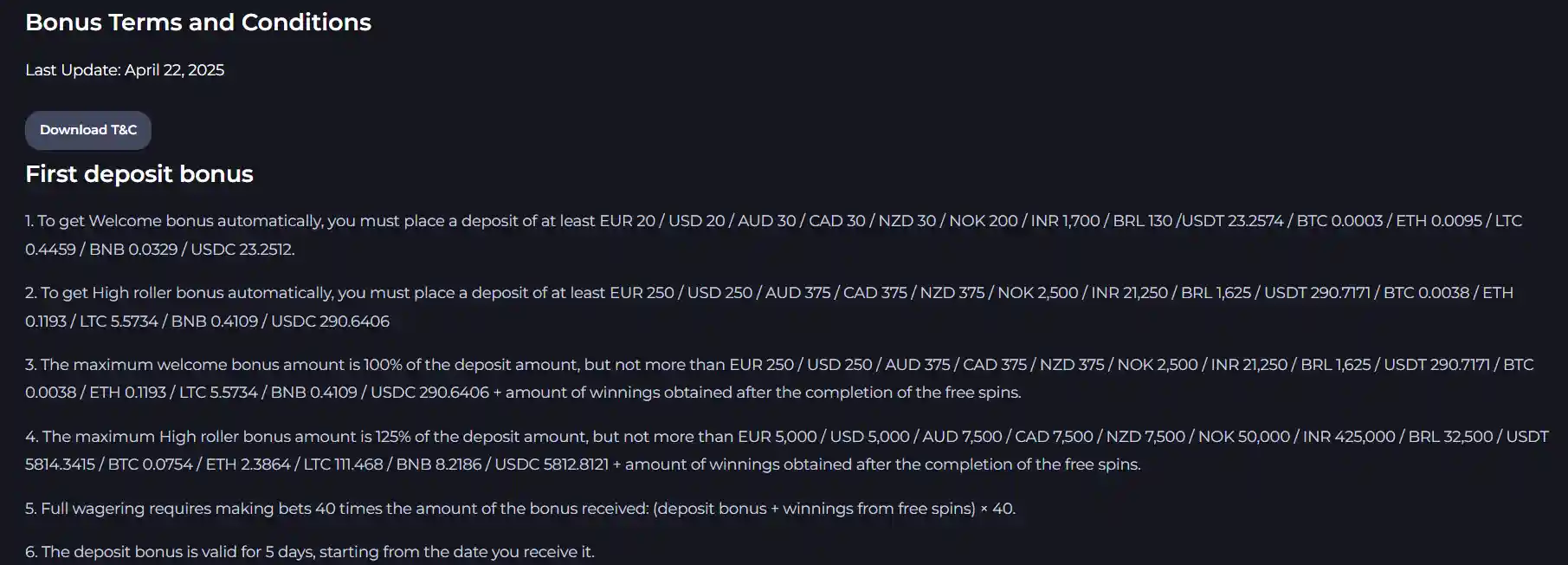
The first term to find is

Then check the game-contribution table. A specialist review describes slots as counting at 100% toward a requirement, while blackjack may count at 10–20%. At a lower contribution rate, a wager adds less toward completion than the same stake on a fully contributing game. Some games may not count at all. That distinction can make a headline bonus look far simpler than the conditions beneath it.
Free spins need their own check. Read the terms to see whether winnings are subject to wagering, whether a cash-out limit applies and which games qualify. “Free” describes the spins, not necessarily the conditions on anything they return. If the restrictions are hard to find or the wording leaves basic questions unanswered, I would not treat the advertised value as money available to withdraw. Fine print matters.
A stake cap can change how a bonus works, too. One specialist review reports offers that restrict each spin to $5 or $10, with the limit intended to prevent “bet-boosting” — raising stakes in a way the offer’s rules prohibit. Those are reported examples, not a universal cap. Check whether the restriction applies while the bonus is active, whether it covers every eligible game and what happens if a spin exceeds the limit. A breach may affect the bonus or related winnings under the stated terms.
Attention: Bonus expiry periods (such as 30 days) can lead to the forfeiture of unused funds; always verify when the clock starts for your specific offer.
Expiry is another easy detail to miss. A specialist review reports a 30-day expiry period for bonuses, after which unused funds may be forfeited. That does not establish a deadline for every offer; the published terms need to specify the actual date or time limit. Look for whether the clock starts when the offer arrives, when it is claimed or when qualifying play begins. I have learned the annoying way that an attractive balance on a screen can disappear when its conditions run out.
For any VIP casino welcome or deposit offer, separate the headline amount from the rules governing it.


Loyalty Points: What Play Earns and When They Expire
A loyalty balance can look like a tidy score of how much you have played. It is not that simple. Points are generally tied to eligible wagers, and the rules decide which games count and how much of each wager is recognised. A large balance is not a direct measure of money spent, nor does it tell you what the points are worth.
There is an important Australian caveat before getting into the mechanics: the Interactive Gambling Act 2001 prohibits operators from providing real-money online casino games to people in Australia. So if an offshore site advertises a VIP loyalty program, its points schedule is not an endorsement or a sign that the service is lawful here. Treat online claims cautiously.
Where a program does award points for play, pokies may earn them at a different rate from table games or live dealer titles. A report by thecork.ie describes eligible pokie wagers earning one point per AU$10 wagered, but that figure should be read as that report’s account of a particular arrangement, not a standard Australian rate. The same report puts pokies at full contribution toward points and describes table and live dealer games as contributing at a lower rate, commonly 10% to 20%; video poker has a separate rate. Those figures are not universal terms.

The broad pattern is also described by bignewsnetwork.com: slots can generate points at a higher rate than table games and live dealer play. The gap matters if you are comparing activity across game types, but the operator’s rules are what count. I’ve learned not to assume that every dollar wagered moves the counter by the same amount. It may not.
“Every spin counts” sounds reassuring. The useful question is what the program calls eligible play. Check the points table for exclusions, game-specific rates, and whether a displayed balance is pending or available. Don’t infer the rate from the VIP label or from another site’s description. Small print first.
Expiry rules need their own check. A report by thecork.ie says some platforms reset points monthly or quarterly, while others allow them to remain indefinitely. That is a description of differing arrangements, not a promise about any particular account. Look for the expiry or reset clause in the program terms, and check whether the date applies to all points or only a particular balance. If the terms are unclear, ask the operator to explain them in writing before relying on the balance.
Points and status are distinct; a points balance may expire under its own rules while a Tier is assessed separately under membership conditions.
Points and status are also different things. A points balance may change under its own expiry rules, while a Tier can be assessed separately under membership conditions. Don’t assume that keeping one preserves the other.
I would keep a simple record of the rate shown, the eligible games, and the expiry wording whenever a program makes those details available. If the terms change, the record helps you spot it. And if the offer is attached to real-money online casino play while you are in Australia, the legal issue comes first—not the points counter.
What VIP Rewards Can Be Worth
A points balance looks useful only once you know what it can buy. That sounds obvious, but I’ve seen the word “reward” do a lot of heavy lifting: a balance can be displayed prominently while the available redemption is narrow, conditional or less valuable than it first appears.
Reported redemption options include bonus credits, free spins and, in some cases, cash. Those are not interchangeable. Cash is straightforward to value; bonus credit or spins may come with restrictions on use or withdrawal. Before treating any displayed amount as money in your pocket, read the redemption terms and check whether the reward can actually be withdrawn. A big number on a screen is not the same thing as cash.
One published report from thecork.ie describes a conversion of 100 points for AU$1 in cash-back credit. Treat that as a reported programme example, not a standard rate across operators. The useful comparison is the value you can redeem, not the number of points a site chooses to award. If one programme gives points quickly but restricts what they can become, while another has a slower-looking balance with a clearer cash option, the headline totals tell you very little.

I’d also separate a reward’s face value from its practical value. A bonus credit can look generous until its conditions make it difficult to use. Free spins can sound like a clean perk, but the terms determine what happens to any winnings. A cash redemption may be easier to understand, yet still depend on the operator’s rules. Read the conditions before you count any of these as a return.
At the upper end, benefits may not be limited to account credit. A report from bignewsnetwork.com says some top-tier players at Australian platforms have received event tickets, hotel stays or electronics. That is a report about possible benefits, not a promise that a particular member will receive them. These perks are harder to compare: an event ticket may matter to you, while an item you would not buy has little personal value. “Exclusive” is not the same as worthwhile.
There is a larger issue for Australians considering online offers. The Interactive Gambling Act 2001 prohibits operators from providing real-money online casino games to people in Australia. A points menu or a VIP label does not change that legal position. So I would not treat a reward claim as a reason to use an online casino-style service. The promotion itself is not evidence that the service is lawful here.
For an in-person membership, the calculation is different: you are looking at benefits attached to a venue’s programme, rather than an online balance presented as a casino reward. The names and conditions matter, and a points-to-cash conversion should never be assumed to apply across programmes. Check what the reward is, how it can be used and what restrictions sit around it.
Reward Valuation
- Value only what can be redeemed under clear, written terms
- Understand that bonus credits and spins often have restrictions unlike cash
- Recognise that a high points total does not equal high practical value
- Remember that online rewards do not make a prohibited service lawful
My rule is simple: value only what you can redeem under clear terms, and don’t let a points total make the decision for you. A reward is still conditional.
Crown Rewards, The Star Club and Playing In Person
Crown Rewards and The Star Club are in-person membership programmes, not proof that an online “VIP club” is a lawful option for Australian punters. I used to blur those things together: a club name sounded like a promise of special treatment wherever I played. It isn’t. These names belong to physical casino membership, and the rules depend on the venue and the activity.
At Crown Melbourne, you need a registered YourPlay account linked to your Crown member account to play gaming machines. A membership card alone does not meet that condition. YourPlay also lets members set time or money limits. A specialist review explains that once a limit is reached, machine play is paused until the next limit period starts. That is a hard stop, not a prompt to try another machine.
There is a separate restriction around fully automated table games: after you reach your PlaySafe limit, you cannot earn points on those games until 6am the following day. I’d check how the limit applies before sitting down, rather than assuming that a membership card means every form of play keeps counting.
Crown Sydney has its own process. Casino membership there requires a separate application and is assessed under separate criteria; don’t assume a Crown Melbourne account automatically gives you access. The Star Club is another named Australian membership programme. I’d read its current membership terms directly rather than infer particular benefits from the name or from what another venue offers.

Membership also has maintenance conditions. Under the stated Crown membership rule, members need to meet the minimum requirements for their entry Tier by the end of the twelve-month Membership Cycle. If they do not, they are moved to the Tier that matches their eligibility. That matters if you treat a card as a permanent badge. It may not be.
There is a practical difference between being enrolled and having activity recorded correctly. Keep the right account or card linked before play, and check that the activity appears against your membership afterwards. If it hasn’t, ask the venue how it was recorded while the details are still clear. I learned not to leave that sort of check until months later.
So when someone says “exclusive” in a pitch for an in-person club, I translate it as “subject to that programme’s rules.” The label does not erase YourPlay limits, venue-specific applications, or Tier requirements. Read the actual membership conditions before relying on a perk or assuming your account carries across locations. Small print matters.
Private Rooms and Crypto: Check the Fine Print
A “VIP room” sounds like a private upgrade, but the label does not mean you can walk in whenever you want. Access to a Private Gaming Room is subject to fair-use policies, and entry can be refused. That matters more than the glossy wording: a room invitation is not a permanent pass, and VIP status alone does not settle whether you’ll be admitted.
I’d treat an offer of private-room access as a specific invitation with conditions, not as a guaranteed part of membership. Check what the operator says about eligibility, booking or approval, and whether access can be withdrawn. If those details are unclear, ask before making plans. A host can explain the process, but the offer itself does not override the room’s rules.
Access to Private Gaming Rooms is subject to fair-use policies, and entry can be refused regardless of your VIP status.
The setting can also make the experience feel more exclusive than the practical benefit warrants. “Private” describes the space, not a promise about service, privacy in every sense, or a particular outcome. Keep those separate in your head. Nice room, still rules.
The crypto angle needs a different kind of caution. A site using cryptocurrency language alongside VIP claims may make the package sound tailored or unusually flexible; that wording alone does not establish what the VIP benefit is, how it works, or whether it is available to you. Read the actual terms for the promotion or membership, including how eligibility is decided and what restrictions apply. Don’t infer a special room invitation, personal service, or other perk from a crypto label.
There is also a more basic issue for Australians: the Interactive Gambling Act 2001 bars operators from supplying real-money online casino-style games to people in Australia. That covers games such as slots, poker, blackjack and roulette. The Australian Communications and Media Authority enforces the federal rules and can ask internet providers to block sites offering prohibited gambling services or advertising them. Its enforcement actions have led to more than 1,455 illegal gambling and affiliate websites being blocked since November 2019.
So an offshore site’s VIP page is not the same thing as a locally authorised online casino offer. The fact that a site mentions a foreign licence or accepts a particular payment method does not change the Australian legal position. I wouldn’t treat a crypto payment option as evidence that a service is safe, approved, or exempt from the rules.
If you are considering an in-person private room, confirm the access conditions directly with the venue. If you are looking at an online casino promising VIP treatment to Australians, pause over the legal context before handing over money or personal details. “Exclusive” is a marketing word; the terms and the law still apply.

Which Games Count Most Toward VIP Progress?
A game can look like it counts fully toward a promotion while adding far less to a VIP tally. I learned to check which calculation the terms mean: wagering progress on a bonus and progress towards membership status are not automatically the same thing.
For wagering requirements, pokies are commonly assigned a 100% contribution. Table games may count at a lower rate, so the same amount wagered can move the requirement along more slowly. That is a rule for the offer, not a promise about VIP status.
For loyalty activity, the rate depends on the operator’s rules. The Cork’s coverage reports that table games and live dealer titles can be assigned a contribution as low as 10% of the pokie rate. Treat that as a reported example, not a standard for every programme. A live dealer table may look like ordinary blackjack or roulette, but the format does not tell you how much activity the operator credits.

Video poker is worth checking separately. It may have its own contribution rate rather than being treated like pokies or table games. If the terms do not spell out how it counts, do not assume that a similar-looking game earns the same credit.
The practical comparison is simple: find the game category, the relevant contribution rate and whether the rule applies to bonus wagering or VIP progress. I once skimmed past that distinction and read “counts” as “counts equally”. It didn’t.
There is also an important Australian limit here. Under the Interactive Gambling Act 2001, operators cannot provide real-money online casino games, including pokies, poker and table games, to people in Australia. So these comparisons should not be read as a recommendation to use an offshore online casino or chase its VIP status. For a specific offer, the terms may explain its accounting, but they do not change the law.
A label such as “VIP slot games” is marketing shorthand, not a reliable guide to contribution. The game name matters less than the written rule beside it. Check that first.
How does VIP tier progression work?
In lawful, in-person casino programs, entry to the base tier may be automatic once you meet the entry conditions. Higher tiers may require an invitation or progression through accumulated points.
Is Crown Rewards Melbourne an online casino account?
No. A membership club at a physical casino is different from an offshore website’s online casino account or VIP promotion.
How do loyalty points convert to cash at Australian online casinos?
A common arrangement is 100 points for AU$1 in cashback credit. Points may also be redeemable for bonus credits or free spins, and cashback credit is not necessarily the same as withdrawable cash.
Do pokies earn more loyalty points than table games?
Usually, yes. Pokies commonly earn points at the full rate, while table games and live dealer games often earn at a lower rate, commonly 10% to 20% of the pokies rate.
Do loyalty points expire?
Some programs reset points monthly or quarterly, while others let them carry over indefinitely. Check the program’s terms for its reset schedule.
How do VIP tiers progress and what are the thresholds?
Programs commonly use tiers that advance through activity or accumulated points; some make higher tiers invitation-based. Specific thresholds and any ongoing activity needed to keep a tier are set by each program.

Prepared by the JeetCity Casino editorial staff.