
Best Pokie Machines to Play in Australia: A Guide
 Available in AU
A practical look at machine features, free play, odds and the legal limits on real-money online pokies in Australia.
Table of Contents
- Online Pokies in Australia: What the Law Actually Says
- What Changes from One Pokie Machine to Another
- Free Play Is Useful—Just Don’t Mistake It for a Preview
- What a Casino Floor Can Tell You About Pokies
- Jackpots, Bonus Features and the Price of Chasing Them
- Pokie Odds: Why Past Spins Don’t Help You Pick the Next One
- Real-Money Play: Deposits Don’t Remove the Risk
- Pokie Apps and the Spin on Your Screen
- New Pokie Names, Familiar Jackpot Mechanics
- RTP and a Few Tips That Don’t Pretend to Beat the Machine
Online Pokies in Australia: What the Law Actually Says
The legal line around online pokies in Australia is aimed at the business offering the game, not at the resident who plays. Under the Interactive Gambling Act 2001, it is an offence for an operator to provide real-money online pokie machine games to people in Australia. The rule covers online casino-style gambling services, including slots, when they are offered to customers here.
That distinction matters. An Australian resident who plays real-money pokies through an offshore operator is not committing an offence under this Act. But that does not make the operator’s service lawful in Australia, or mean an offshore licence is an Australian one. There is no Australian licence for a business to offer real-money online pokies to Australian residents.
I used to read “available to Australians” as though it meant “approved here”. It doesn’t. A website may be accessible, or may say it accepts Australian customers, while still offering a service that operators are prohibited from providing under federal law. Access and legality are separate questions.
Choosing a pokie machine is only part of the decision; the casino behind it also matters. Use these operator details as a reference when deciding where to play in Australia in 2026.
License: Curacao eGaming (Roby Games Ltd) Roby Casino is listed with a Curacao eGaming licence held by Roby Games Ltd.
License: Curacao eGaming OGL/2023/174/0082 (Dama N.V.) · Min. deposit: A$15 LevelUp Casino is listed with a Curacao eGaming licence, OGL/2023/174/0082, held by Dama N.V. Its minimum deposit is A$15.
License: Curacao – Antillephone N.V. (Versus Odds B.V.) · Min. deposit: EUR 20 Thor Casino is listed with a Curacao licence from Antillephone N.V., with Versus Odds B.V. named. Its minimum deposit is EUR 20.
Payout speed: crypto 30-120 minutes, fiat 24-72 hours · Min. deposit: A$30 MrPacho lists crypto payout times of 30–120 minutes and fiat payout times of 24–72 hours. The minimum deposit is A$30.
License: Curacao Gaming Control Board OGL/2023/176/0095 (Hollycorn N.V.) Neospin is listed with a Curacao Gaming Control Board licence, OGL/2023/176/0095, held by Hollycorn N.V.
License: Curacao Gaming Control Board (TechSolutions Group N.V.) Bizzo Casino is listed with a Curacao Gaming Control Board licence held by TechSolutions Group N.V.
License: Curacao Gaming Control Board OGL/2023/176/0095 (Hollycorn N.V.) Rollero Casino is listed with a Curacao Gaming Control Board licence, OGL/2023/176/0095, held by Hollycorn N.V.
License: Curacao Gaming Authority (Jumpman Gaming Ltd) DragonSlots Casino is listed with a Curacao Gaming Authority licence held by Jumpman Gaming Ltd.
License: Curacao Golden Pokies is listed with a Curacao licence.
License: Curacao OGL/2024/1335/0780 · Min. deposit: EUR 20 Vegaz Casino is listed with a Curacao licence, OGL/2024/1335/0780. Its minimum deposit is EUR 20.
Who enforces the federal rules?
The Australian Communications and Media Authority, usually shortened to ACMA, is the federal body that enforces the Interactive Gambling Act and monitors compliance with interactive gambling laws. Its work includes action against prohibited gambling services and advertising aimed at people in Australia.
ACMA can ask Australian internet service providers to block access to websites that provide prohibited interactive gambling services or advertise them. A block is an access measure: it can make a site harder to reach through an Australian internet connection, but it does not turn an offshore service into a locally licensed one. Nor does a website remaining reachable establish that its offer complies with Australian law.
The scale of this enforcement is substantial. Following enforcement action, ACMA has blocked more than 1,455 illegal gambling and affiliate websites since November 2019. Those blocks include both gambling services and affiliate sites associated with them; the figure is not a count of pokie games or of Australian players.
There is also a reported count of services that have left the Australian market since ACMA began enforcing the rules in 2017. Here the published figures conflict: one account puts the number above 210, while another says more than 190. Both describe withdrawals since 2017, but they do not give the same total. The important point for a player is the enforcement pattern, not treating either count as a guarantee that a particular site has been checked or is safe.
What the rule means for a player
The Act’s prohibition is directed at operators providing the service. It does not make an Australian resident a criminal simply for playing real-money pokie machine games online with an offshore operator. That difference is easy to lose in broad warnings that say “online pokies are illegal” without clarifying whose conduct the law addresses.
Still, the absence of an offence for the player is not the same as consumer protection. If an offshore business withholds winnings or closes an account, a player may have no effective local regulatory recourse. A site’s own terms, customer support or claims about an overseas licence do not create an Australian licence for online casino gambling. I would not treat a polished website as proof that an Australian authority can resolve a dispute with it.
The same legal distinction applies whether someone searches for an online pokie machine, a simulator, or real pokie machine games online. The key issue is not the game’s graphics, software or pokie machine paylines; it is whether a business is offering
There are serious penalties for breaches of the Act: the stated maximum daily penalty is $360,000 for an individual and $1.8 million for a body corporate. These figures concern people or companies who breach the law; they should not be confused with a penalty imposed on a resident merely for playing at an offshore site.
Legal Risk
Under the Interactive Gambling Act 2001, it is an offence for operators to provide real-money online pokie services to people in Australia, and these services lack local licensing and consumer protection.
So the practical reading is plain, if less tidy than a banner saying “legal” or “illegal”: operators cannot lawfully offer real-money online pokies to Australian residents, while players are not prosecuted under this Act simply for taking part. ACMA can pursue services and seek website blocks, but a block is not a seal of approval for sites that remain online. Access is not authorisation.
What Changes from One Pokie Machine to Another
A pokie can look familiar at a glance and still work quite differently once you sit down. The useful details are usually on the screen or in the game rules: the paytable, the paylines and the way the machine lets you set your stake. I used to pick by graphics first. That was an easy way to miss what I was actually signing up to play.
The paytable is the place to check what combinations pay and how much they return at the selected bet. Symbols that look important are not necessarily worth the same amount, and a feature shown in the artwork does not tell you its payout by itself. Take a moment to read the prize table rather than guessing from the theme. It is less exciting than pressing spin. Still useful.
Paylines describe the paths across the reels that can produce a win. Some pokie titles use a fixed number of lines; others allow the player to vary how many are active. That affects how to read the stake controls, because a displayed bet may depend on the chosen line settings. If the machine offers variable paylines, check which ones are selected before you play. Otherwise, it is easy to misunderstand what a spin costs or which patterns count.

A fixed-line game removes that particular choice, but it does not make every machine equivalent. Paytables differ, and so can the number and arrangement of paylines. I’ve learned not to treat two games as interchangeable just because they share a familiar reel layout. The screen can show you the rules; the name and artwork cannot.
At Crown Perth, minimum bets vary by machine, with typical per-spin minimums ranging from $0.20 to $2.00. So the first stake you see on one machine may not be available on the next. If you are comparing machines there, check the displayed minimum before settling in, then look at the bet controls to understand what changes when you adjust the stake or paylines. A game that looks like a comfortable choice can have a different entry point from the one beside it.
That is also why “best” is a slippery label. A machine’s paytable might suit what you want to understand, while its minimum bet or line setup may not fit how much you intended to stake. There is no single layout that makes a pokie right for everyone. Start with the rules you can inspect: what combinations pay, how many lines are in play, and what the selected bet means.
If the information is tucked into a help screen, open it before playing rather than trying to work it out mid-session. I have rushed past those menus and then spent the next few spins wondering why the game behaved differently from what I assumed. That was my mistake, not a clever feature.
One more practical point: the amount shown as a bet is about the cost of a spin, not the price of owning a machine. In a casino, you choose from the stakes offered on that particular game. At Crown Perth, that minimum can vary across the floor, so a quick check is more useful than assuming every pokie starts at the same level.
A better choice is not necessarily the flashiest pokie or the one with the most lines. It is the one whose rules and stake settings you have actually read, and whose minimum you are comfortable with before you begin. Check first. Then decide.
Free Play Is Useful—Just Don’t Mistake It for a Preview
A free demo can be handy for finding your way around a pokie. You can see how the buttons work, watch the reels move, read the feature instructions and get a feel for the theme without putting money at risk. If I’m looking at an unfamiliar game, that’s the part I want to check first: can I follow what the screen is telling me, or am I just tapping through animations?
It can also help you decide whether you actually enjoy a game’s pace and presentation. A pokie may look polished in a screenshot but feel busy once its sounds, pop-ups and bonus prompts are all going at once. Free play lets you inspect that experience before committing to anything. It’s a tour, not a forecast.
The important distinction is that demo results do not tell you what will happen in real-money play. A demo win is not evidence that the same game is about to pay when you switch modes, and a string of demo losses is no reason to expect a win next. Online pokie results come from software using a random number generator; each spin stands on its own rather than carrying forward a memory of earlier spins. The demo and real-money versions may look alike, but the results you see in one session cannot predict the other.

That’s where I used to fool myself. A good run in free play made a game feel “ready” for me, as if I’d found a rhythm I could carry over. I hadn’t. I was reacting to a run of results that had no predictive value. Treat demo mode as a way to learn the controls and rules, not as a practice run that trains you to win. No secret rhythm.
Pay attention to what the game explains, too. Read the feature descriptions and see what happens when special symbols appear. Some games have bonus rounds with their own rules, and free play can make those easier to understand without pressure. If the instructions are confusing, that’s useful information in itself. You don’t need to force yourself to like a game just because its theme or advertised feature sounds exciting.
Bonus free spins are a different thing from a free demo. A demo lets you play without risking your own stake; bonus spins are offered as part of a promotion and can come with conditions attached. Any winnings from those spins may be treated as bonus funds rather than immediately withdrawable cash. Check the wagering requirement and cashout terms before accepting. The headline may say “free”; the conditions still matter.
- Use demos to learn controls and rules.
- Check wagering requirements for bonus spins.
- Read cashout terms before accepting bonuses.
- Treat demo wins as a forecast for real play.
- Assume a “free” bonus has no conditions.
- Use demo results to find a winning rhythm.
A specialist review describes one bonus example with a 30x wagering requirement: a $100 bonus would require $3,000 in bets before cashout. That is an illustration of how a particular offer can work, not a standard that applies everywhere. The actual terms depend on the offer. If the rules are hard to find or you can’t tell which games count toward the requirement, don’t assume the promotional headline tells the whole story.
There’s another practical trap: mixing up a bonus with low-stakes practice. If your aim is simply to learn how a game works, demo play does that without tying your decision to a promotion. If you accept bonus spins, you may be taking on wagering conditions and withdrawal restrictions as well. Those are different choices, even when both are described as free.
So use the demo for what it’s good at: checking a pokie’s layout, instructions and feel. Enjoy a lucky run if one happens, but don’t read it as a preview of real-money results. And before taking a bonus, read the terms that determine whether its winnings can actually be withdrawn.
What a Casino Floor Can Tell You About Pokies
Crown Perth gives you a concrete place to look at what a casino pokie machine actually shows, rather than judging one from a game name or a promotional description. It is Perth’s sole legal land-based casino, and its floor holds more than 2,500 gaming machines. That is a large choice of machines, but sheer choice does not tell you which one will suit you—or which one will pay out during your visit.

The useful thing about standing at a machine is that you can inspect its information before putting money in. In Western Australia, every legal pokie must display its rules, paylines and prize table. I would take a moment to read those screens instead of treating the cabinet graphics or a big feature name as a guide to what the game costs or how its prizes work. The rules explain the game’s structure; the prize table shows which outcomes correspond to which prizes.
RTP is another figure people look for when comparing machines. Most machines at Crown Perth fall within an
That distinction matters when you are trying to find the “highest-paying” pokie. A broad range for most machines does not establish which individual machine has the highest RTP, and RTP is not a forecast of what your session will return. A machine’s prize table can help you understand its listed prizes, but it does not tell you that a particular payout is due. No magic cabinet. No secret corner.
I used to think the busier-looking machine, or the one with the more exciting top prize, must have some practical edge. That is a poor way to choose. The information on the machine is more useful than the atmosphere around it: read the rules, check the paylines and prize table, then decide whether the game’s setup makes sense to you. If it does not, move on rather than trying to work it out while the credits are running down.
Crown Perth RTP
Most machines at Crown Perth fall within an RTP range of 87% to 92%, though the casino does not provide a machine-by-machine list.
A pokie machine simulator can help you learn how a game’s buttons and features work, but it cannot tell you what a real machine on the casino floor will pay. The physical machine’s displayed information is the relevant place to check its rules and prizes. Even then, reading the screen is not a method for predicting a win; it is simply a way to know what you are playing.
Crown Perth’s scale makes it a useful example of the range available in a legal casino, not a shortcut to a “best Australian pokie machine.” There is no single pick established by the number of machines, the casino’s name or a general RTP range. I would choose by understanding the specific machine in front of me, not by chasing a claim that one cabinet is bound to pay more. Read first. Play second.
Jackpots, Bonus Features and the Price of Chasing Them

I used to read a growing jackpot as a reason to stay put. It felt as if the machine was “due”; really, I was letting the displayed prize turn ordinary spins into a chase. A larger progressive prize does not make the next spin more likely to pay it. It just makes the potential prize more visible. Easy to forget. Hard to ignore.

The price can make a bonus look like a shortcut: skip the build-up and get straight to the part with the special symbols and animation. But buying access to a feature does not buy a particular result. The free spins can still produce an outcome that feels underwhelming, and the extra cost is spent whether the feature delivers a memorable win or not. The animation is not a receipt for value.
That is the distinction I keep in mind: a networked progressive jackpot is a shared prize pool that can grow across linked machines or casinos; a feature buy is an extra charge to enter a bonus round. Neither changes the basic uncertainty of the game. One puts a large prize on display, the other puts a price on skipping ahead.
If you are choosing between them, look at what the game is actually asking you to pay for. With a progressive, the jackpot can dominate the screen while the chance of hitting it remains uncertain. With a feature buy, the cost is immediate and explicit, but the bonus outcome is not. I would treat both as entertainment with a price attached, not as a clever route around the ordinary game.
The expensive shortcut is still a bet.
Pokie Odds: Why Past Spins Don’t Help You Pick the Next One
I used to treat a run of losses as evidence that a payout had to be close. It felt logical: surely the machine was “due”. It wasn’t. Each pokie spin is independent, so earlier results have no effect on the next outcome. A streak can happen, but it doesn’t tell you what the next spin will do.
Volatility describes the shape of a game’s payouts, not a way to predict them. A low-volatility pokie tends to pay smaller amounts more often.

That distinction matters more than a dramatic sound or a screen full of flashing symbols. Pokie machine sounds can make a win feel bigger, or a near miss feel significant, but they don’t change the odds of the next spin. I’ve let the noise get under my skin before. It’s atmosphere, not a signal.

RTP is another figure people can mistake for a session forecast. It describes the share of all money wagered that a game returns across a very large number of spins. It does not say what you’ll get back during your own play. A specialist review lists Gates of Olympus at 96.5% RTP and Sweet Bonanza at 96.48%. Those figures are close, but neither means one is more likely to pay you in the next few spins. They are reported settings for those titles, not a promise about an individual session.
So when someone asks for the best pokie machine to win, I’d be wary of any answer that sounds certain. A higher stated RTP can be useful when comparing versions, but it cannot tell you whether a particular run will go well. Even two games with similar RTP can feel very different if their volatility differs.
If you’re deciding how to play a pokie machine, start by noticing whether you’re comfortable with its payout pattern, rather than trying to read a “hot” or “cold” streak. And if the game is frustrating you, switching machines won’t make past spins carry over or reset your luck. There’s no memory in the spin.
No secret pattern.
Real-Money Play: Deposits Don’t Remove the Risk
A deposit can make the money feel abstract. It isn’t. Once cash is in an account, every spin still comes out of your own budget, and a payment method does nothing to change that. I’ve found it easier to decide what I can afford to lose before opening a game, then stop when I reach that figure. Set a loss limit while you’re still thinking clearly. Don’t top it up because a session feels close to turning around.
There’s an important Australian context: offshore sites may list ways to fund an account, but that does not make real-money online pokies a lawful service for people here. A specialist review of offshore gambling sites describes methods such as Visa, Mastercard, bank transfer, Bitcoin and Ethereum. That is a description of what some sites advertise, not a recommendation to deposit. Credit cards should not be used for online gambling.
Attention: Using credit cards for online gambling is not recommended, and offshore operators may leave you without effective legal recourse if they withhold winnings.
The payment step is only half the transaction. A withdrawal can remain pending for 24–72 hours, and during that wait a site may prompt you to reverse it and keep playing. I’d treat a withdrawal request as a decision already made: don’t cancel it just because the balance is still visible. Offshore operators may also leave you without effective legal recourse if they withhold winnings. That risk is easy to overlook when a deposit takes less thought than getting money back.
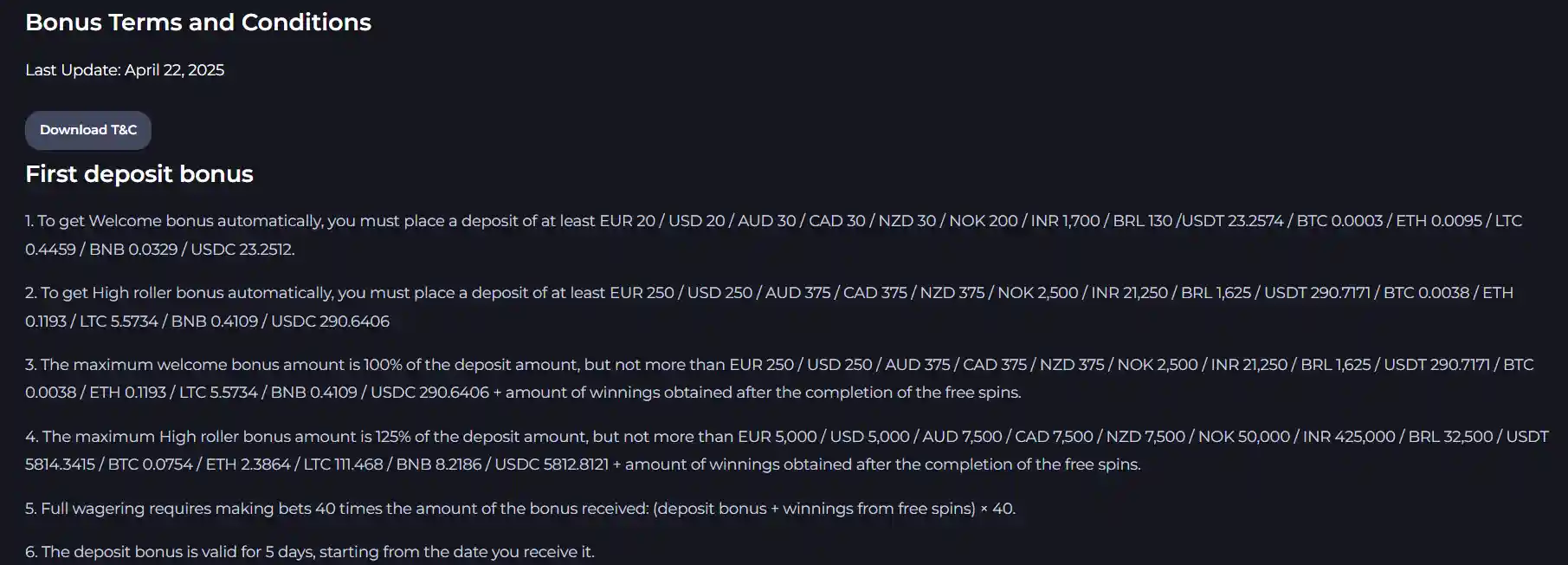
Bonuses need the same scepticism. A headline offer is not cash in your pocket: wagering conditions can require substantial betting before funds become withdrawable. Requirements such as 35x or 40x can make a bonus difficult to clear, and free-spin winnings may be bonus funds subject to wagering rules and cashout limits. Read the terms before accepting; if the conditions are unclear, declining the offer is a reasonable choice.
I used to think a payment going through meant the hard part was done. It doesn’t. Keep deposits within the loss limit you set, avoid borrowing to continue, and don’t count a displayed balance or promotional bonus as money you can safely spend. If you’re already chasing losses, adding another payment method won’t fix the problem. Stop there.
Pokie Apps and the Spin on Your Screen
A pokie can feel different on a phone: the screen is smaller, the controls sit under your thumb, and it is easier to keep tapping without noticing how long you have been playing. That is a change in how you interact with it, not a reason to expect different results. Online pokie outcomes are generated by a random number generator, and every spin is independent of the one before it. A run of blanks does not make a win due.

I have caught myself treating the phone like a shortcut: one more spin while waiting, then another because I was already there. It is an easy habit to slide into. Decide what you are willing to lose before opening a game, and stop when you reach that limit. The app cannot make a session predictable.
When choosing a pokie app, look past the word “best”. Check that the game is actually the one you meant to open, that its controls are clear on your screen, and that you can see the bet before you spin. If a button is close to another control or the display makes the stake hard to read, pause rather than tapping through by muscle memory. A smoother interface can make play easier to navigate; it does not improve the chance of a win.
You may also see “pokie machine API” in technical descriptions. An API is a way for software systems to communicate; the label alone tells you nothing about the game’s fairness or the result of an individual spin. It is not a strategy, and it does not turn an app into a way to predict a jackpot.
Treat the cost of playing on a phone as real, even when the screen makes each spin feel small. Check the amount shown before confirming a bet, and keep track of the total rather than judging by the last few taps. If you are distracted, tired or trying to recover a loss, close the app. No clever interface can undo money already wagered.
Mobile Play Facts
- App interfaces change interaction, not the game results.
- Outcomes are generated by a random number generator.
- Every spin is independent, regardless of the device used.
- Mobile access is a convenience, not a strategic edge.
A jackpot can look especially close on a bright mobile display, but its appearance does not tell you that it is about to land. The same independent-spin rule applies whether you play on a phone or another screen. Convenient access is all it is. Not an edge.
New Pokie Names, Familiar Jackpot Mechanics
A fresh name on a pokie can make it look like there must be a fresh kind of game behind it. I’ve learned not to read too much into the label. Names such as Cash Express and Dragon Link are recognisable because they’re associated with networked progressive jackpots: machines, or casinos, contribute to a shared jackpot rather than keeping the prize confined to one machine.
That shared pool is the useful detail. The name tells you what family of game you’re looking at; it doesn’t tell you that the jackpot is waiting to land, or that a new-looking title is a better choice. It’s a signpost, not a prediction.
I used to treat a familiar name as a reason to keep playing. If the title had a big jackpot attached, I’d think I was getting closer by sticking around. That was wishful thinking. A progressive prize can grow as play contributes to it, but the title itself gives you no way to know when it will be won.
A name isn’t a signal.
When you come across a new pokie machine, look past the artwork and ask what the name is pointing to. Is it part of a networked jackpot series, like Dragon Link or Cash Express? That tells you something about how the prize is connected. It does not tell you how likely you are to win it, or make one title a sounder pick than another.
Lightning Link is another name tied to this kind of networked jackpot. Seeing it alongside Dragon Link or Cash Express helps explain why these titles turn up across multiple machines: the appeal is not only the individual game, but the shared progressive prize.
So when new pokie machine games appear with polished names and familiar jackpot language, I try to separate curiosity from confidence. A title can be worth a closer look without being a reason to chase. The jackpot mechanic is the part that matters here; the name is just how you spot it.
RTP and a Few Tips That Don’t Pretend to Beat the Machine
RTP is a long-run measure: it describes the share of all money wagered on a pokie that is returned to players across a very large number of spins. It is not a prediction of what will happen in your session. A figure on a game screen can look reassuring, but it cannot tell you whether your next spins will pay anything back.
There is another detail worth checking: some providers let operators select from several RTP settings for the same title. So the version available to you may not match the figure shown in a review or elsewhere. Check the specific pokie’s information at the place you are considering playing, rather than assuming every copy has the same setting.
I used to treat a higher RTP like a quiet hint that I had found the sensible choice. It isn’t a short-term edge you can count on. Individual sessions can vary widely, and a high RTP does not ensure a win. That’s the part the tidy number leaves out.

What law governs online gambling in Australia?
The Interactive Gambling Act 2001 governs online gambling services. It makes it an offence for operators to offer real-money online pokies to people in Australia.
How much money do I need to play pokies?
At Crown Perth, minimum bets typically range from $0.20 to $2.00 per spin, depending on the machine.
Is online gambling legal in Australia?
Operators cannot lawfully offer real-money online pokies to Australian residents under the Interactive Gambling Act 2001. An Australian resident does not commit an offence under that Act simply by playing through an offshore operator.
Are online pokies legal for Australian players?
Operators are prohibited from offering real-money online pokies to people in Australia, but Australian players are not committing an offence under the Interactive Gambling Act 2001 simply by playing through an offshore operator.
Created by the ”JeetCity Casino” editorial team.