

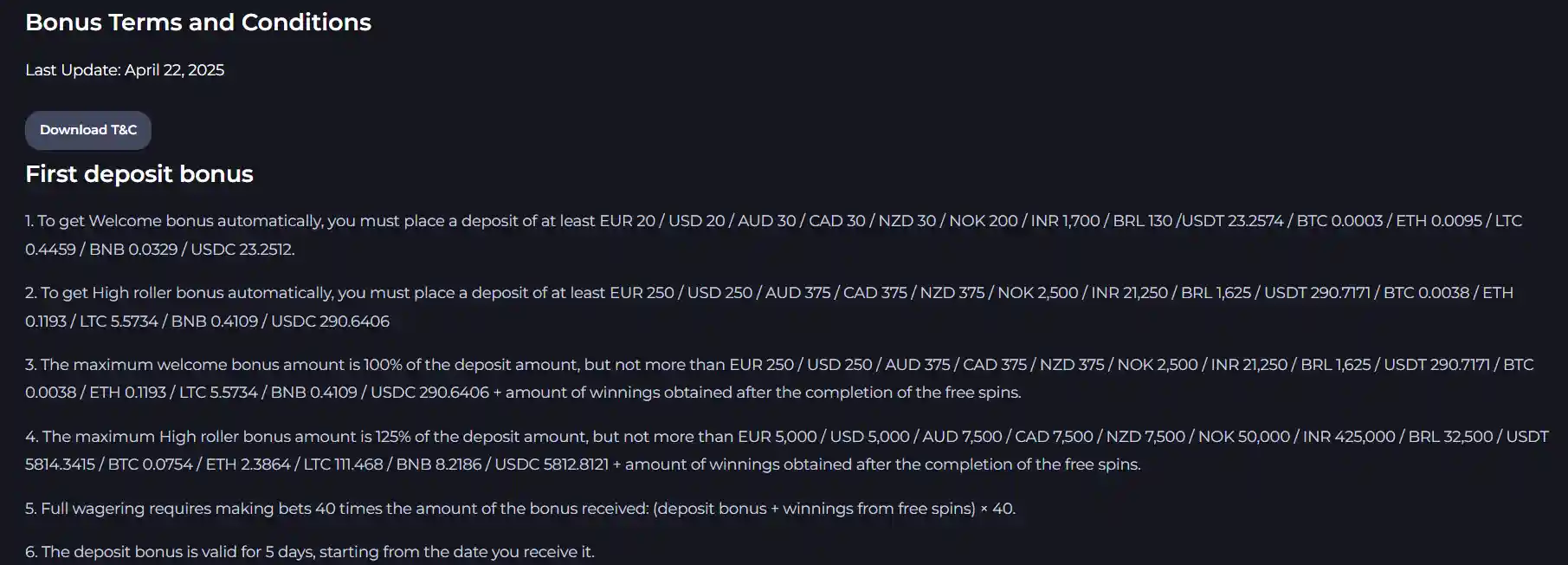



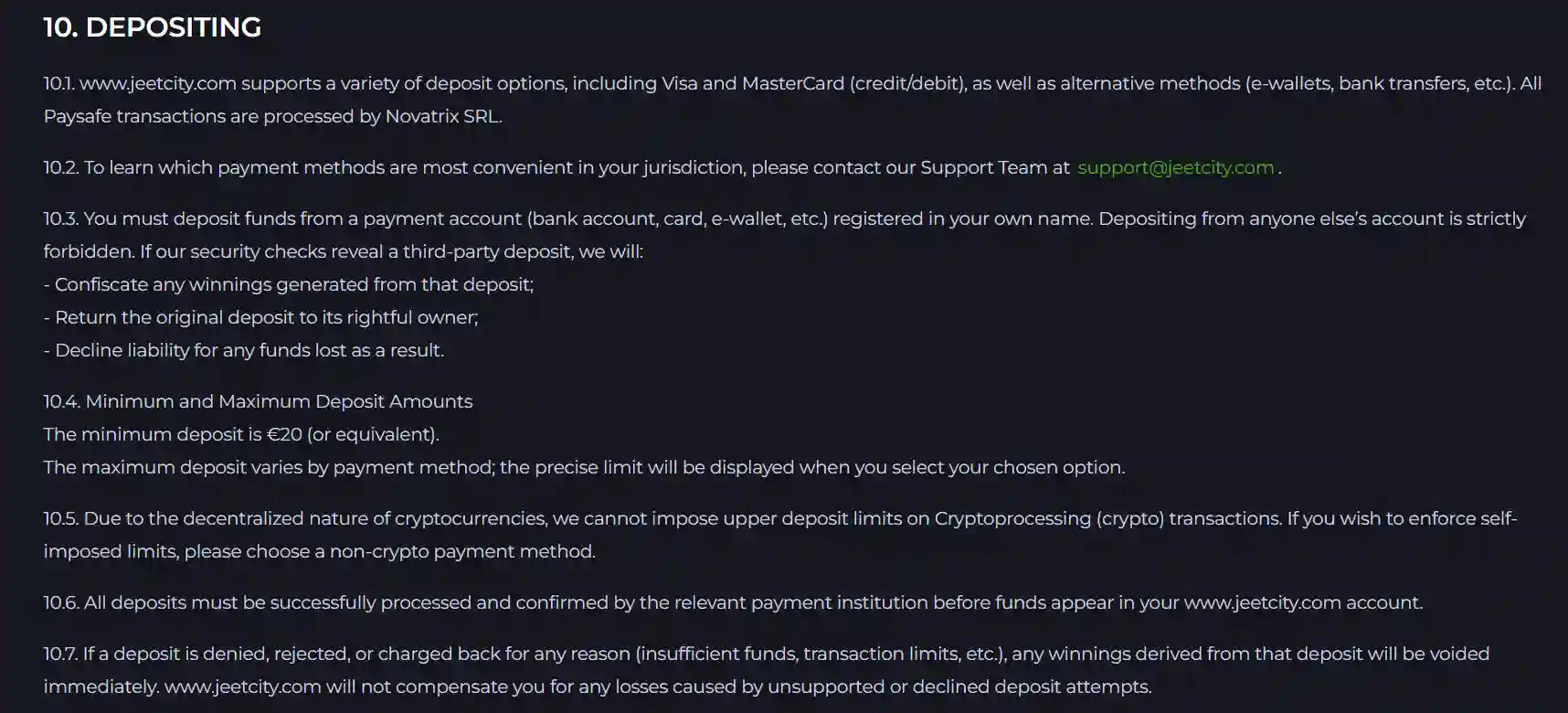

No Minimum Deposit Casinos in Australia: What It Means
 Available in AU
A casino’s deposit policy and a payment provider’s minimum are separate rules, with bonus and cash-out conditions adding further limits.

Table of Contents
- What “No Minimum Deposit” Actually Means
- The Australian Rules Behind Offshore Casino Access
- Why a Small Deposit Can Still Be Awkward
- Crypto Deposits: Low Minimums, Real Costs
- Real-Money Play Starts With the Cash-Out Rules
- Pokies on a Tiny Bankroll: Bonus Rules Matter
- Slots, Wagering Contributions, and the Fine Print
- “Withdrawable” Bonus Money Has Conditions
- Bitcoin Deposits: Check the Practical Minimum
- PayPal Minimums: Check Before You Count on Them
What “No Minimum Deposit” Actually Means
“No minimum deposit” sounds like a simple promise: put in whatever amount you choose, even a very small one. In practice, it usually describes only one part of the transaction. The operator may have no deposit floor of its own, while the payment method or the processor handling the payment sets a separate minimum. Those are different rules, and the headline only tells you about the first one.
I used to read the phrase as if it applied to the whole payment. It doesn’t. An operator can say it will accept deposits of any size without setting a minimum, but that does not make every payment route capable of sending any amount. The cashier can show a payment option with its own threshold, or a processor can reject a transfer that falls below the amount it handles. In that case, the operator’s rule is still technically “no minimum”; the payment itself simply cannot be made at an arbitrarily low amount.
Think of it as two separate gates. The operator decides whether its account system has a minimum deposit requirement. The payment route decides whether it will process the amount you enter. To work out what the label means for a particular transaction, you need to look at both. If either gate has a floor, that floor determines the smallest amount that can actually reach the account.
If you’re looking for a casino with no minimum deposit in Australia, check the deposit terms carefully: the information available for these operators does not establish that any of them accepts a zero-minimum deposit. The details below highlight the specific verified information available for each.
License: Curacao eGaming (Roby Games Ltd) Roby Casino is listed with a Curacao eGaming license held by Roby Games Ltd. No minimum-deposit information is provided here.
License: Curacao eGaming OGL/2023/174/0082 (Dama N.V.) · Min. deposit: A$15 LevelUp Casino has a stated minimum deposit of A$15, so the information provided does not describe it as a no-minimum-deposit option. Its license is Curacao eGaming OGL/2023/174/0082, held by Dama N.V.
License: Curacao – Antillephone N.V. (Versus Odds B.V.) · Min. deposit: EUR 20 Thor Casino has a stated minimum deposit of EUR 20, rather than a stated zero minimum. It is licensed in Curacao by Antillephone N.V. for Versus Odds B.V.
Payout speed: crypto 30-120 minutes, fiat 24-72 hours · Min. deposit: A$30 MrPacho has a stated minimum deposit of A$30, so it is not presented here as a no-minimum-deposit option. Its listed payout speeds are 30–120 minutes for crypto and 24–72 hours for fiat.
License: Curacao Gaming Control Board OGL/2023/176/0095 (Hollycorn N.V.) Neospin is licensed by the Curacao Gaming Control Board under OGL/2023/176/0095, with Hollycorn N.V. named as the operator. No minimum-deposit information is provided here.
License: Curacao Gaming Control Board (TechSolutions Group N.V.) Bizzo Casino is licensed by the Curacao Gaming Control Board, with TechSolutions Group N.V. named in the licensing information. No minimum-deposit information is provided here.
License: Curacao Gaming Control Board OGL/2023/176/0095 (Hollycorn N.V.) Rollero Casino is licensed by the Curacao Gaming Control Board under OGL/2023/176/0095, with Hollycorn N.V. named as the operator. No minimum-deposit information is provided here.
License: Curacao Gaming Authority (Jumpman Gaming Ltd) DragonSlots Casino is listed with a Curacao Gaming Authority license and Jumpman Gaming Ltd. No minimum-deposit information is provided here.
License: Curacao Golden Pokies is listed as licensed in Curacao. No minimum-deposit information is provided here.
License: Curacao OGL/2024/1335/0780 · Min. deposit: EUR 20 Vegaz Casino has a stated minimum deposit of EUR 20, so the information provided does not describe it as a no-minimum-deposit option. Its listed license is Curacao OGL/2024/1335/0780.
That distinction matters when comparing claims. “No minimum” may mean the operator does not require a particular starting balance before accepting a deposit. It does not necessarily mean the payment screen will accept a tiny amount, that the processor will send it, or that every listed method follows the same rule. A payment option can have different conditions from another option at the same operator. Treating the headline as a guarantee about every route is the easy mistake.
A specialist review has described the effective minimum for a usable deposit in Australia as falling between
When checking a claim, separate the operator’s terms from the payment instructions. Look for whether the operator states a deposit minimum at all, then check the selected method’s own requirements and any notice shown before payment. A general page that says “no minimum” may not explain the conditions for each route. The final amount entered in a payment form is more useful than the slogan, but even that is only clear once the transaction terms have been shown.

There is another small wording trap: a minimum deposit is not the same as a minimum amount that is useful to you. The first is a rule about whether a deposit may be accepted. The second depends on what the payment route permits and what the account’s terms require. The phrase only addresses the first issue when it is describing the operator’s policy. It says nothing by itself about whether a particular amount will be accepted by a processor or serve any practical purpose.
So when you see “no minimum deposit online casino” language, read it narrowly. It can mean the operator has not set a minimum deposit threshold. It cannot, by itself, establish that every payment method has no floor. Nor should the phrase be treated as proof that a service is available or lawful for Australian residents; it is a payment-policy claim, not an endorsement or a statement about legal status.
I now read the claim as the beginning of a check, not the end of one. Find the operator’s deposit rule, identify the payment route, and check that route’s own minimum before relying on the wording. If those details are not presented together, the headline leaves an important gap. Small print, big difference.
- Separate operator terms from payment instructions
- Check the selected method’s own requirements
- Look for notices shown before payment
- Treat “no minimum” as a guarantee for every route
- Rely on the slogan instead of the final payment form
- Assume the operator’s rule applies to the processor
The Australian Rules Behind Offshore Casino Access
A “no minimum deposit” label only describes an offer; it says nothing about whether the service is lawful to provide in Australia. That distinction matters more than the size of a first payment. The federal framework treats real-money online casino games as a restricted service, not as an ordinary product that becomes acceptable because a website is easy to reach or carries an overseas licence.
The central law is the Interactive Gambling Act 2001, usually shortened to the IGA. It remains Australia’s main federal law for online gambling. In practical terms, the Act makes it illegal for operators to provide real-money casino games to people physically in Australia. That includes pokies and table games such as blackjack and roulette, as well as online poker. The rule is about the service being provided to people here; a site’s Australian branding does not change what kind of service it is.

That point can get blurred when a website describes itself as an Australian casino. Most sites using that branding operate under a licence issued outside Australia, with Curaçao, Malta and the Isle of Man among the jurisdictions commonly named. An overseas licence is not an Australian authorisation, and it does not override the IGA. I’d treat “Australian” in a brand or marketing page as a description aimed at local customers, not proof that the operator is licensed under Australian law.
There is also an important distinction between the operator’s position and the player’s. The IGA restricts operators from supplying prohibited services to people in Australia, but it does not make an individual’s act of placing a bet with an offshore operator a criminal offence. That does not turn offshore casino play into a regulated or endorsed activity. It means the legal framework places the prohibition on providing the service, rather than criminalising the customer simply for making a bet.
For readers in New South Wales, the federal rules still matter: the IGA applies across Australia. State and territory arrangements may also be relevant to gambling matters, but the key point here is that a local state reference in a site’s branding does not make prohibited online casino services lawful. A “no minimum deposit casino” promoted for NSW is not exempt from the federal position because it mentions a state or caters its page to local users.

The Australian Communications and Media Authority, or ACMA, is the federal body that enforces the IGA and monitors compliance with interactive gambling laws. Its role is not just to publish warnings. When ACMA identifies a website providing prohibited gambling services or advertising them in Australia, it can ask Australian internet service providers to block access to that site. A block can make a site harder to reach from Australia, though it does not itself tell you everything about the operator, its licence or how it handles customers.
The enforcement figures give a sense of the scale of that work, but they should be read as enforcement figures, not as a complete count of every offshore site. ACMA says it has blocked more than 1,455 illegal gambling and affiliate websites since November 2019, following enforcement action. Those are blocked websites, including affiliate sites; the figure is not a count of convictions or a list of every operator that has left the market.
Legal Status
The Interactive Gambling Act 2001 makes it illegal for operators to provide real-money casino games to people physically in Australia.
There is a reported discrepancy in another figure. One account says more than 210 illegal services have withdrawn from Australia since ACMA began enforcing the rules in 2017, while another gives the number as more than 190. Either way, the figures describe services that withdrew, not a guarantee that a particular site is safe, lawful or permanently unavailable.
I would not read continued access as a sign of approval. A website may load at one point and be blocked later, and an offshore licence does not prevent Australian enforcement. Equally, a blocked page does not mean the customer has committed an offence by trying to visit it. The central risk is that the service sits outside Australia’s domestic online-casino framework, while access and enforcement can change.
That leaves a less tidy picture than the advertising suggests: operators face the prohibition, ACMA can act against prohibited services, and players are not criminalised simply for betting offshore. None of those points amounts to a recommendation to use such a site. The law is the boundary; a deposit label is not an exception.
Why a Small Deposit Can Still Be Awkward
“No minimum” can sound like a green light for a tiny top-up. In practice, it may only mean the casino itself has not set a floor. The payment route can still reject a small amount, add a fee, or leave you waiting long enough that the deposit stops feeling convenient.
PayID and instant bank transfer are often presented as quick ways to move money, but the minimum can still matter. One specialist review puts the typical minimum deposit for these methods at AU$10–AU$20; treat that as a reported range, not a promise that every operator or processor follows it. If you were hoping to put in less, check the cashier before starting. A payment screen that accepts only a larger amount is the real limit for that transaction.

Fees change the maths too. A fee on a small payment takes a bigger bite out of it than the same fee would from a larger one. A specialist review also reports that Skrill and Neteller deposits to gambling sites may attract fees and often have a A$10 minimum transaction amount. That can make a nominally small deposit more expensive than it first appears. I’ve made the mistake of looking only at the amount I wanted to send, then noticing the extra cost at the last step. Annoying, and entirely avoidable.
Bank transfers can be an especially poor fit when you are trying to move a small amount quickly. They may take several business days to process, and the sending bank may charge a fee. A deposit that is delayed or reduced by charges is not much use as an instant top-up. Check both the expected processing time and any fee shown by your bank before confirming.
There is also an old Australian payment option people may remember: POLi. It shut down in Australia on 30 September 2023, so old references to it should not be mistaken for a currently available way to pay.
POLi shut down in Australia on 30 September 2023 and is no longer a currently available way to pay.
The same caution applies when you see a cashier offering PayID, PayPal or another familiar label. A method’s name alone tells you neither whether it is available for that account nor what minimum or fee applies. Read the payment screen and the terms for the specific transaction. If the operator sets no deposit floor but the processor does, the processor’s rule is what you will run into.
I’d treat a small deposit as practical only after checking the amount accepted, any charge, and how long the payment can take. “Instant” can describe the transfer interface, not necessarily every step between your bank and the account. A tiny amount may be technically accepted and still be awkward to use. Check first.
Crypto Deposits: Low Minimums, Real Costs
A crypto deposit can look tiny on the casino’s side of the screen. That does not mean the same amount is useful once network charges, conversion and the size of individual bets are taken into account. The advertised minimum is only one part of the calculation.
A specialist gambling review reports that some offshore operators have accepted cryptocurrency deposits from as little as A$5. A separate specialist review describes casino-set crypto minimums as sometimes equivalent to just A$1. Those are reported examples, not a dependable standard: payment rules change, and an amount accepted by one service may not work with another. “No minimum” can mean only that the operator has set no floor of its own. It does not remove limits or costs elsewhere in the payment chain.

The first catch is the transfer itself. A crypto network may charge a fee to process a transaction, and the fee can make a small transfer disproportionately expensive. If the amount sent is close to the fee, little may remain for play. If the casino credits funds in a different currency or token from the one sent, conversion can introduce another cost or an exchange-rate difference. The exact result depends on the network and the services involved; the headline deposit figure cannot tell you what will arrive.
Then there is the practical question of what the credited balance can do. Games have minimum bet sizes, and those can differ between games. A balance that technically clears a deposit threshold may still be too small to place a bet, or may allow so few bets that it is not a meaningful bankroll. This is where “low minimum” turns into marketing language: accepted is not the same as usable.
I have made the mistake of judging a payment by the amount shown on the deposit page and ignoring the amount that would actually be available afterward. With crypto, I would treat the full path as one calculation: what leaves the wallet, what fees or conversion may apply, what the service credits, and whether that balance can cover the intended bets. If any part of that is unclear, the small minimum is not much of a selling point. Cheap-looking, not necessarily cheap.
There is an important Australian context here. The Interactive Gambling Act 2001 prohibits operators from providing real-money online casino games to people physically located in Australia. A foreign payment option or an offshore site’s willingness to accept a transfer does not change that rule, and this explanation is not a recommendation to use such a service.
Attention: A low operator-set minimum can be made impractical by network fees, conversion costs, and minimum game bet sizes.
So the useful distinction is between a nominal threshold and a workable amount. A very low operator-set minimum may be possible in a particular offer, but fees, conversion and game bet sizes can make it impractical. The number on the deposit screen is only the start of the arithmetic—not a promise that a small transfer will go far.
Real-Money Play Starts With the Cash-Out Rules
A small deposit tells you very little about whether you could actually get money out. The figure that matters is the cash-out threshold: an operator may let you add a small amount, while requiring a larger balance before it will accept a withdrawal request. I used to treat “no minimum” as the whole story. It isn’t.
Specialist reviews report withdrawal minimums in the range of A$20 to A$50 at some offshore casinos. That is a reported range, not a rule for every service; the amount and conditions can differ between operators and payment methods. If your balance sits below the applicable floor, it may not be eligible for cash-out yet. Check the cashier terms before you put money in, not after you have a balance you want to access.
The details matter. Find the minimum cash-out amount, any fees, and whether the operator requires identity checks before processing a request. Also look for limits on the amount that can be requested at once and any stated processing stages. A payment method can be quick at one stage and slow at another: the operator may need to review the request before the payment provider sends it. “Fast” can mean the request is approved quickly, not that the funds are already in your account.

Processing time is not one clock
Specialist reviews describe PayID and cryptocurrency as among the quicker cash-out routes reported by Australian-facing offshore casinos. They report that PayID can arrive the same day, while USDT sent over the TRC-20 network may clear within minutes once account verification is complete. Those timings are reports, not guarantees. Verification, operator processing, network conditions and the receiving account can all affect the wait.
I would separate three things when reading a payout claim: how long the operator takes to approve the request, how long the payment network takes to move it, and when your bank or wallet makes it available. A “minutes” claim may refer only to the transfer after approval. If your account still needs verification, that step can come first.
Do not assume a method is available just because it appears in a general payment guide. Check the cashier and the cash-out terms for the particular service, including which currencies and networks it supports. With cryptocurrency, a network mismatch is not a minor delay; it can mean the transfer does not reach the intended wallet. With PayID, confirm the destination details and any instructions shown for the transaction.
There is a broader issue for Australians: the Interactive Gambling Act 2001 prohibits operators from providing real-money online casino games to people in Australia. A published cash-out policy does not change that legal position or guarantee that an offshore service will remain accessible. ACMA enforces the federal rules and can seek website blocking. So a promise about payment speed should never be read as a promise of reliable access or recourse.
Before making any decision, read the withdrawal terms as carefully as the deposit page. Check the threshold, processing sequence, verification requirements and supported method. If the information is unclear, that uncertainty is part of the risk—not a detail to sort out later. A balance on a screen is not the same as money received.
Pokies on a Tiny Bankroll: Bonus Rules Matter
A small balance can make a bonus feel like a way to stretch play. The catch is that the wagering requirement may treat different games very differently. Before you start, check the terms for the games you intend to play—not just the headline offer.

I’d treat “eligible games” as a phrase to inspect, not a green light. The terms may distinguish between game types, and the contribution rate matters. Check the stated weighting for each category before playing. If the terms are unclear, don’t assume that every game counts equally.
Then there’s the maximum stake. Some promotions set a cap on how much you can wager on a single spin while the bonus is active. One stated example is a $5 limit; going over the promotion’s cap can void winnings. It may be one oversized bet, not a long run of reckless play, that turns a bonus balance into a problem.

That rule is easy to miss when you’re focused on making a small balance last. I would check the maximum stake before starting and keep each bet below the stated limit throughout wagering. If the offer has separate rules for spins and other games, read both rather than assuming the same cap applies everywhere.
Small print bites.
Before accepting a bonus, I’d look for three things in the terms: the maximum bet during wagering, the game weighting, and any maximum cashout cap. The cap matters because clearing wagering does not necessarily mean every resulting amount can be paid out. These are separate conditions, and one does not cancel out another.

My old mistake was reading the offer first and the restrictions after I’d started. Now I’d check the terms before any play, especially the game weighting and maximum stake. If those conditions don’t suit your budget, leave the bonus alone.
Slots, Wagering Contributions, and the Fine Print
A game’s contribution rate can change how much wagering counts toward a promotion’s requirements. In the terms,
Game Contribution Examples
Pokies commonly contribute 100% toward wagering requirements, whereas blackjack and roulette may only count for 10% or 20%.
I used to glance at the headline offer and assume every game would move the counter along at the same pace. That was the wrong thing to assume. A contribution rate is a calculation rule, not a promise that a bonus will be easy to clear. If table games count for less, wagering the same amount there may add less progress than wagering on pokies.
The wording matters. “100% contribution” means the full eligible wager is counted toward the wagering requirement; it does not mean the stake comes back, or that the bonus is already withdrawable. And a listed rate only helps if the game is eligible under that promotion’s terms. The fine print can specify which games count and whether the advertised contribution applies to every game in a category.
Before confirming a bonus, I’d check three things together: the minimum deposit needed to activate it, the wagering multiplier, and the game weighting for pokies versus table games. Checking only one can leave you with the wrong picture. A low deposit requirement does not tell you how much wagering is attached, and a generous contribution rate does not cancel the multiplier.
I also wouldn’t treat a higher contribution as a reason to accept a promotion. It tells you how the operator calculates progress, not whether the offer suits your budget or whether the terms are workable. If the conditions are unclear, that uncertainty is part of the decision.
Read the rules first. Then decide.
“Withdrawable” Bonus Money Has Conditions
“Withdrawable” can sound like the money is already yours. I used to read it that way. In practice, a bonus balance may still be locked behind a wagering requirement: a set amount of bets that must be placed before bonus winnings can be cashed out.
The multiplier matters more than the headline figure. A specialist review describes low-deposit bonuses with wagering requirements ranging from 35x to 50x the bonus amount. That is not a universal rule, so read the specific promotion’s terms rather than assuming every offer uses the same calculation.
The arithmetic can get ugly quickly. A specialist review gives this illustration: a $1,000 bonus with a 35x wagering requirement calls for $35,000 in total bets before bonus winnings become eligible for cash out. That figure is the required turnover, not an amount you are expected to lose, but repeated bets still put your balance at risk. Big difference.
Check what the multiplier applies to. If it is calculated on the bonus alone, the target differs from a term that counts both your deposit and the bonus. Then look for the time allowed, any maximum stake while wagering, and a cap on cashable winnings. A small headline offer can come with conditions that decide whether any resulting balance is payable.
I now treat the bonus figure as conditional credit, not spendable cash. Until the wagering requirement is cleared and the other terms are met, the balance may not be available to cash out. If the rules are hard to find or the calculation is unclear, I would rather judge the offer without the bonus.
Read the full terms before opting in, and keep a note of the multiplier and what it applies to. “Free” is the sales word. The conditions are the real price.
Bonus Wagering Calculation
Assume a $1,000 bonus is awarded.
Apply a 35x wagering requirement to the bonus amount.
$1,000 × 35 = $35,000 in total bets required before winnings can be cashed out.
Bitcoin Deposits: Check the Practical Minimum
A “no minimum deposit” label can sound as if a tiny Bitcoin transfer will get you playing. I’ve learned not to treat the casino’s stated floor as the amount that makes sense to send. A specialist review has reported crypto deposit thresholds as low as the equivalent of A$1, but that is a reported example, not a dependable promise about every operator or a measure of what you can usefully do with the funds.
Bitcoin has costs beyond the amount credited to an account. A network fee may apply to the transfer, and the casino may require the deposit to reach its wallet before crediting it. When the amount is very small, those costs can take a meaningful bite out of what arrives. The casino’s displayed minimum and the amount that makes a practical deposit are different things.
Then there is the bet size. If the games available to you require stakes larger than your balance can sensibly support, a low deposit threshold does not buy much room to play. You might technically meet the funding minimum and still have too little to make the deposit useful. That distinction is easy to miss when the headline is built around the smallest possible number.
Before sending Bitcoin, check the amount the operator says it will credit, whether network costs affect the transfer, and the minimum stake for the games you intend to play. Don’t assume a deposit can be reversed if you change your mind; cryptocurrency transfers are not the same as cancelling a card payment.
There is also a legal limit in Australia: the Interactive Gambling Act 2001 prohibits operators from providing real-money online casino games to people located here. A low Bitcoin threshold does not change that. I wouldn’t treat “no minimum” as an invitation or a sign that a service is lawful. The advertised floor is only one number. Your usable balance, and the rules that apply, matter more.
PayPal Minimums: Check Before You Count on Them
A “no minimum” claim can describe the operator’s own rule, not the amount PayPal will let you send. The casino may set no deposit floor while a payment method or its processor applies a separate limit. Those are different checks, and one does not cancel the other.
I would not assume PayPal is available just because a page mentions it, or that a small payment will go through because the operator advertises no minimum. Availability and transaction conditions can depend on the service and the payment route offered at the time. There is no single PayPal threshold I can responsibly give you here.
Before relying on it, check the cashier screen and the terms attached to the specific payment option. Look for the minimum shown for the transaction, any fee, and whether the amount is stated in Australian dollars or another currency. If the details are unclear, do not treat a general “no minimum” claim as confirmation that PayPal will accept the amount you intend to send.
I have seen how easy it is to read a headline as a promise. It isn’t. The useful figure is the one displayed for the actual method, before you confirm anything—not a broad claim about the operator.
There is also a bigger point for Australians: a payment option does not make an offshore real-money casino service lawful. The Interactive Gambling Act 2001 prohibits operators from providing online casino games to people in Australia. Keep that separate from the narrow payment question. Even a displayed PayPal route is not an endorsement or a reason to overlook the legal position.
So, if you are checking whether PayPal can be used for a small deposit, verify the method’s own conditions rather than relying on the operator’s deposit wording. If the cashier does not clearly state what applies, pause. No guesswork.
What is the actual minimum deposit at a no minimum deposit casino in Australia?
A practical minimum is often AU$10–AU$20, even if the casino itself sets no deposit floor. Some cryptocurrency routes may accept less, but the payment method can set its own minimum.
Are no minimum deposit casinos legal in Australia?
The Interactive Gambling Act 2001 prohibits operators from providing certain real-money online casino services to people in Australia. The Act does not criminalise an individual for placing a bet with an offshore operator, and an overseas licence does not make the service Australian-authorised.
What is the minimum deposit and wagering requirement?
A usable deposit commonly starts at AU$10–AU$20, while some cryptocurrency deposits may be lower. Low-deposit bonuses can have wagering requirements of 35× to 50× the bonus amount.
Do low deposit bonuses have wagering requirements?
Yes, they may require wagering of 35× to 50× the bonus amount. Slots usually count fully toward the requirement, while blackjack and roulette may count for only 10% or 20%.
What payment method is best for small deposits in Australia?
Cryptocurrency can allow deposits as low as AU$5, and some casinos set its minimum at the equivalent of AU$1, though fees and minimum bets can make very small deposits impractical. Neosurf vouchers typically start at AU$10; bank transfers are less practical for small deposits because of delays and possible fees.
Can I withdraw winnings from a low deposit?
Yes, but a minimum withdrawal commonly applies, typically AU$20–AU$50. Bonus wagering requirements may also need to be completed before bonus winnings can be withdrawn.
Can I legally deposit and withdraw money to online casinos?
The Interactive Gambling Act 2001 prohibits operators from providing certain online gambling services to people in Australia, but it does not criminalise an individual for placing a bet with an offshore operator. That does not mean offshore casino play is regulated or endorsed in Australia.

Prepared by the JeetCity Casino editorial staff.